Book I · Nonfiction
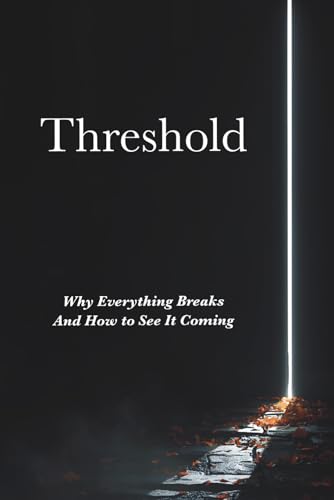
Threshold
Why Everything Breaks — And How to See It Coming
Every living system maintains internal reference points. Below them, inertia dominates. Once crossed, outcomes become inevitable. The change feels sudden. It never is.
About the book
You're constantly crossing them. The question is whether you see them coming.
Threshold unveils the hidden rule governing biology, psychology, organizations, and societies: responses are not gradual; they are triggered when accumulated signals cross an internal reference point. This mechanism is identical whether the system in question is a single neuron, a long-term relationship, a tech company, or a civilization.
The book teaches you to see thresholds before they are crossed, to measure how close you are, and to intervene while the window is still open. The reward is time.
What you'll learn
- → Why every major change in your life felt sudden, but wasn't
- → How to map the signals that predict a crossing before it happens
- → Why you stay too long in things that stopped working
- → How power operates through threshold control, from relationships to civilizations
- → The single question behind all human behavior: What self is being preserved?
of Being Unknown
A Self-Devouring Text
in Four Infections
Book II · Literary Fiction
On the Advantage
of Being Unknown
Notes from Underground, Part II — A Self-Devouring Text in Four Infections
What you hold is a disease disguised as a book. The only honest continuation is nothing. Proceed at your own risk.
About the book
His brain is a prison of his own construction. Every feeling, every memory, every act of love, analyzed until it proves itself performance and disappears. He is not stupid. That is exactly the problem.
Structured as four infections, the text fragments as his narrator proceeds: journal entries, then mathematical proofs, then footnotes that slowly crowd out the narrative. The editor begins finding his own handwriting in the margins three years before he discovered the pages. You are already the next chapter. The doorman knows this. He is happy. You are not.
For readers of
Stay in the loop
Get notified about both books, new writing, and the occasional threshold analysis of something worth watching.
Newsletter coming soon